

Long Play Project Essay: Ian Neal - This Gemlike Flame
The sounds of 70s Genesis in a 2026 new release.

The Long Play Project is an exploration of the musician, the unknown, and the album. I treat the album as a critical case study into human creativity and radical innovation.
In response to feedback, I’m tweaking the way membership works a little. A paid membership is the focus for my audio productions: the monthly audio essay, and an extended version of my podcast beginning in September. (For full details, see the About page.) Free subscribers receive all of my written features and essays.
The Long Play Project publishes on a four week cycle, usually on a Sunday. We’re on week three. Week one considered Peter Gabriel and his fifth album So. If you missed it, the essay is here. Week two was the LP Select curated playlist, and week four is the first audio essay.
Who is Ian Neal, and how does he fit with the Project?
Neal describes himself as “a British composer, multi-instrumentalist, and master of vintage analogue synths currently operating from a dedicated studio in Kalamata, Greece. Holding a PhD in Visual Culture and Theory, Neal seamlessly synthesizes the worlds of academic art history and high-fidelity symphonic progressive rock, earning his reputation among listeners as a true ‘doctor of reverie’.”
I’m not, you might be relieved to read, about to attempt an academic treatise. Neal’s new album is of interests for this Project because he both looks back fifty or so years and looks forward with his new compositions.
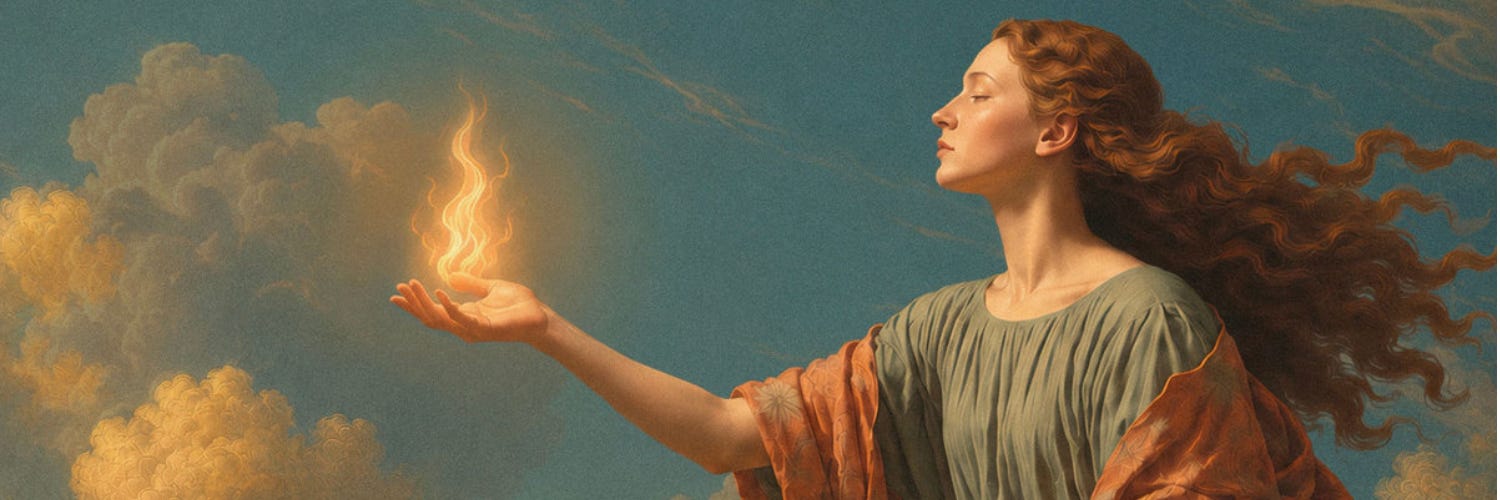
On his Bandcamp page, Neal explains his intentions for This Gemlike Flame: “Long before the era of definitive CD reissues and curated box sets, I was tracking down obscure [Genesis] vinyl B-sides—‘It’s Yourself,’ ‘The Day the Light Went Out’, ‘Naminamu’, and ‘Submarine’—alongside the cinematic textures of Banks’ solo debut A Curious Feeling and Steve Hackett’s early solo masterpieces.
I approach the music as if I am co-habiting that late-70s sonic space—working through it, and with it, simply because, as a composer, its vocabulary is incredibly rich and beautiful to inhabit.”
Neal isn’t alone in his fascination with this period of music. As well as tribute bands, musicians such as Robert Reed are writing new material while standing on the shoulder of a giant - in his case, Mike Oldfield. There are others. Steve Hackett both plays Genesis songs live and creates new music of his own, some of which would be contenders for Genesis if he were still a member (and Genesis were still a band).
Neal says: “The album draws heavily on Genesis 1976-1980, yet I sought to create something that transcends a pure homage to that lineage alone.”
In terms of This Gemlike Flame for The Long Play Project, you might be surprised that an album sonically harking back 40 or 50 years meets my criteria for writing about music that’s pushing the boundaries. The reason it’s allowed in is that Neal is taking those sounds and incorporating them into new music; connecting the current with the past. As with Reed’s albums, This Gemlike Flame doesn’t set out to be a cover version of mid-seventies Genesis albums. Essentially, it asks the question: What other possibilities exist?
This is not merely an exercise in synth technology. On A Trick of the Tail there’s a beautiful Tony Banks/Steve Hackett track called ‘Entangled’. This references what appear to be medical experiments on children, perhaps misguided attempts at helping: “Mesmerised children are playing, / Meant to be seen and not heard, / “Stop me from dreaming!” / “Don’t be absurd!” The children are being hypnotised, as is made clear in the gentle chorus: “As I count backwards / Your eyes become heavier still” and then, “With your consent / I can experiment further still.” My reading is these ‘experiments’ are designed to stop nightmares, and get to the source of their cause. There are legitimate uses of hypnotherapy, and ‘Entangled’ rightly allows for an air of mystery. Musically, the song is both beautiful and disturbing.
Ian Neal comments this story is being told from a secular point of view. His ‘answer’ song is called ‘Cretan Angel’ (is a four-part epic) and, once again, I’ll let Ian tell it his way:
“Cretan Angel (parts i-iii) is heavily indebted to the spirit of ‘Entangled’; not just sonically, but there was a nod to the lyrics as well … the narrative in ‘Cretan Angel’ is a perfect ‘antidote’ to the predatory secular narrative of ‘Entangled’ conjured up by Steve Hackett.
I’ll quote a couple of Ian’s lyrics to demonstrate the point: “Whisper, in my ear, / What dark dreams you may fear. / Sleep now, for a while, / Feel safe in this exile.”
Creating a place of safety, not a false reassurance. “I am here, at your side, /Through this darkness, we will glide. / Enwrapt softly in this veil, / Your soft breath breath will exhale.”
“Part iv, The Marian Veil (6:49-12: 51), looks to the ethereal beauty of ‘Undertow’ and ‘Snowbound’ from ...And Then There Were Three…”
When you buy this album you’ll receive extensive information about the synths, patches, and recording details. Many artists offer studio information, and it’s particularly relevant here given the nature of the project. I’m more able to write about the finished product than the process1, but to give you a taste:
“The 8-bar ostinato pattern in 4/4 that kicks off the track provides the foundation for parts i–iii. That time signature changes in part iv, ‘Misterioso in 11/8’ (6:36 - 8:59). The ostinato pattern here is developed out of the earlier part i pattern and driven by celesta. Vocals in that movement go through a Leslie effect. From 8:59 we enter the final movement, part v, ‘To burn always, with this hard gemlike flame,’ and the time signature moves to 5/4.
Instruments & Effects: Solo synth (ARP 2600); Hammond organ with the Tony Banks signal chain (MXR Phaser => Boss CE-1 Chorus); Mellotron choir.”
A question worth asking is why do this?
Tony Banks and Genesis did all of this decades ago, synthesisers have advanced, and the original records are still readily available. We might only be asking this question because synths are technology, and we always expect tech to be better. When artists recreate the sound of a 30s jazz band, or a classical orchestra sounds as much as possible the way a symphony would have been played a couple of hundred years ago, we don’t question the validity.
Banks might be less of a showman than Rick Wakeman or Keith Emerson, but that doesn’t speak to his playing or technical mastery. Neal takes his inspiration from one of the great keyboard players, not just great within the confines of prog rock but - just great.
Neal’s academic research led him to “a ‘British Dreamscape’ where art history and Romantic poetry feed directly into symphonic progressive rock.” Tony Banks, of course, has made a series of classical albums.
If you enjoy Genesis, This Gemlike Flame is a highly recommended listen. The various directions travelled by the music of Genesis, and my deep appreciation of their music since going back to 1974, it was always likely their extended world would beccome the heart of this Project. Yet it’s also true many different artists will be admitted to the Long Play Project archive, some with a Genesis connection and some with none at all.
Next …
The fourth week of the Project brings my Audio Essay (for paid subscribers) - further reflections on Peter Gabriel’s So. And, the week after, a new cycle begins …
As a writer, I’m becoming drawn to these technical projects. As well as this album, I wrote about The Anchoress and her use of Pete Townshend’s synths in my book. Her use of the Townshend Studio for her new album (review to appear in the Project soon) is another demonstration of how ‘old’ tech can remain current in music.