

The Long Play Project Essay: Diving backwards to move forwards
@TheAnchoress: As Once We Were - released 07/08/26

The Long Play Project tells stories of progressive music, and the imagination behind albums that enrich our lives.
Welcome to the Long Play Project, Catherine Anne Davies AKA The Anchoress
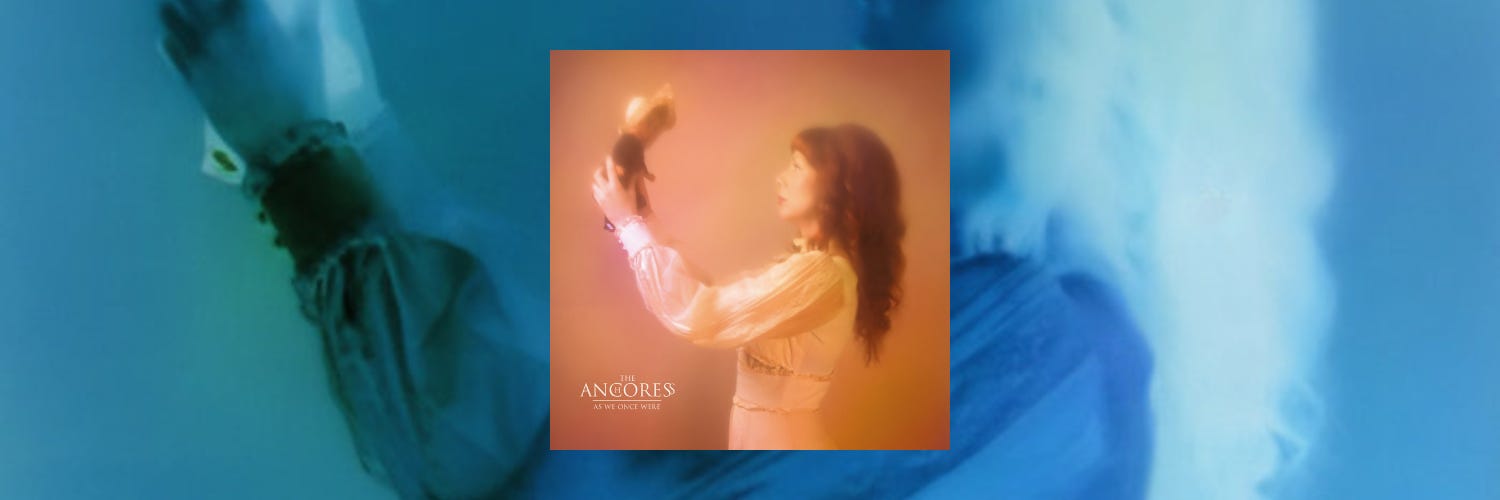
This is a forthcoming release. It also reaches back to the past; technically, and in terms of the way this album came into being, as we’ll see. By making use of The Townshend Studio, she had “private access to one of the world’s most inspiring collections of vintage and analogue synths — drawn from the personal collection of Pete Townshend, a pioneer of sonic experimentation and Ealing Art College alumnus.”
The results will be available in August on her new album, As We Once Were. What have we got here?
It’s best if Catherine herself describes it:
“I found myself diving backwards to go forwards. Hands on the keys of synths once played by the legendary genius of Townshend, tongue in the words uttered by my grandmother, as well as those beginning to emerge from the mouth of my own young daughter. Holding a conversation across the generations, asking questions of the past as a way to propel myself forwards to a future that might look different.”
Album Trailer
One element of the Long Play Project can be found in the Zen Buddhist concept of ‘beginner’s mind’: Shoshin, the practice of approaching life with an open, eager, and unbiased attitude, free from preconceptions.
“In the beginner’s mind there are many possibilities, but in the expert’s mind there are few.” (Shunryu Suzuki, Zen Mind, Beginner’s Mind, 1970)
The Anchoress had an associated concept in mind when writing her new album: Kintsugi, the Japanese art of repairing broken pottery by mending the areas of crack with lacquer mixed with powdered gold. As she says: “through healing and transformation we can create something more valuable than before.”
Join these two concepts together: an open mind full of possibilities, a transformation into something more valuable than before - and creative possibilities cannot do anything other than flow.
Davies opens her track-by-track notes about As Once We Were with a quotation from Joan Didion: “I write to find out what I’m thinking.” It turns out Catherine has many thoughts.
Although I was already aware of The Anchoress, my interest in her new album came into focus when I discovered she was recording in The Townshend Studio, and the synth sounds here were created on the vintage machines used by Pete Townshend in the early seventies, not least on Who’s Next and the Lifehouse project, and I make reference to this in my book, although As Once We Were was at a very early stage when I completed my final draft.
This is a far more interesting project than a vintage synth festival. Catherine discovered a tape recording of her grandmother’s reflections on life, and these form the basis of the lyrical themes. The discovery of the tape coincided with an especially tough period in her life, and the songs she wrote were a way of recording her own reflections on the family situation she was dealing with.
In my book, I explore the possibility that, in one way or another, all of Townshend’s work is connected with his Lifehouse project, including those songs written before there was any formal project for them to belong to. I concluded that ‘all’ is to overstate his direction of travel, but there is a strong Lifehouse line through many of his songs.
Pete Townshend writes to find out what he’s thinking - about spirituality, about society, about people. Catherine Anne Davies writes to find out what she’s thinking.
“We tell ourselves stories in order to live.” ― Joan Didion, The White Album (aff.)
These songs are inspired by the stories The Anchoress told herself.
In her own track-by-track guide, Catherine identifies the songs with the Townshend synths, so let’s begin there.
‘I Had a Baby Not a Lobotomy’. As she comments, those early synths look more like fight controllers than musical instruments. We underestimate the task Townshend set himself in learning to program these odd electronic beasts. Here it’s the ARP 2500. An hour of work set up the sequence we can hear over the top of the chorus; it had to be captured immediately because the chances of getting the same sequence again were small. The song itself is “a tongue in cheek commentary on the persistent quiet misogyny of motherhood”.
‘I Had a Baby Not a Lobotomy’
Catherine first got entangled with the ARP 2500 as part of the synth kitchen sink she threw at ‘What You Did’. This is intriguing; the song itself deals with the past: “the perfect moment of congruence between the concept of the album and the method used to create it.” Also visiting the present from the 70s and 80s here are Yamaha CS80 and Roland Jupiter 8 synths. The synths are used to make something new, not to make a 70s-sounding album. The synths are an act of Kintsugi.
‘She Knows Her Place’ has a fascinating story to acknowledge. This was written both as a sequel to the Beatles’ ‘She’s Leaving Home’, McCartney’s string-laden ballad on Sgt. Pepper, and as a companion piece to ‘I Had a Baby Not a Lobotomy’. In McCartney’s original she’s leaving home to meet a man from the motor trade, and Catherine’s extension of the story is an escape from her parents into a domestic cage of a different sort. Gwenno guests and helped with the Welsh translations. The track is boosted by samples from vintage educational films about the ‘baby blues’ (now properly referred to as ‘post-partum depression’). The vintage synth here is a Yamaha DX1, used for its perfect horn sounds.
This is such an intriguing album. I must underline what an enjoyable listen it is; essays like this can sometimes make complex concept albums sound like technical exercises without soul. This album, arising from lived experience, is all soul, if not strictly soul music.
The album’s structure is an echo of Kate Bush’s Hounds of Love record, with the more complex sonic worlds on ‘side two’, where Bush’s ‘The Ninth Wave’ can be found on her host album. As such, the second section begins with a reprise of the opening track ‘Du Temps Perdu’ - no synths here, just a musical box and an upright piano. As the album opens, we hear the voices of Catherine’s grandmother, mother and daughter; diving backwards to go forwards.
James Dean Bradfield from the Manic Street Preachers guests on ‘Throw Over Your Man’:
‘Damsels’ asks what it means to be a woman across history. This album is progressive music as social history; the antidote to the lazy ‘irony’ of female artists manipulated by men to repeat past mistakes. The Anchoress: “It’s a wry calling out of every man on the internet who’s ever had the gall to complain about there being an International Women’s Day sitting in such a place of social privilege.”
‘All I Really Want is Peace’ calls back to the 70s in terms of the sonic nature of records made then, including the slide guitar that was a feature of many 70s albums. She was also inspired by the harmonies of The Carpenters (I always loved them, too, especially their rock ‘n’ roll radio tribute album Now and Then, which is a strangely fitting title in this context).
At low points in our lives, time seems to stop. In better times, it appears to speed up. Or is time not a constant? Perhaps it does actually move at different speeds, like a river flowing fast and slow (sometimes simultaneously)? in ‘Stop the World’ Catherine plays with this idea by slowing the track to a stop in the final verse, representing a living hell (and a real one; this is biography not fiction) and adding strings played just a little out of tune, representing the world lurching beneath your feet. All this follows a stunning introductory sequence using the voice as a multi-layered instrument, a homage to Brian Wilson and an acknowledgement of the role of the studio in creating, not just recording, music; as it was in the late 60s and even more so in the 70s, and as it continues to be now (even if a ‘studio’ can be almost anywhere these days).
We continue to dive backwards to move forwards. Hannah Peel guests on ‘All Fall Down’, sung over a synth landscape in a meditation on early experience and how we can feel haunted by our past.
On this fascinating album, we’re here now and haunted by then, Townshend synths and all. How much of what we say and do now will resonate into the future?
Next in the Long Play Project
A new playlist of new and newly sprung from the archive tracks - out next weekend - LP Select #076.
Thank you so much for this Ian. If anyone is interested to hear more, the album is released on August 7th and you can preorder it here now: http://found.ee/AsWeOnceWere
It’s available on 2LP, limited cassette, CD mediabook (with 16 bonus tracks and liner notes) and gatefold cd.
I’ve enjoyed her earlier work and now very much looking forward to this album.