
David Bowie - Station to Station
The Thin White Duke returns again, and now he’s 50

“The reasons for doing the show and record were many-faceted. The overriding need for me was to develop more of a European influence, having immersed myself so thoroughly in American culture. As I was personally going through a very bad time, I thought I had to get back to Europe. So it came to that.”
David Bowie - Musician magazine, May 1983

Listen to Station to Station on your preferred streaming service
By 1975, Bowie fans were used to new directions, but ones firmly rooted in rock music (after his initial guise in the sixties as a psychedelic folkie, before he was really ‘David Bowie’). Young Americans was the Philadelphia soul sound Bowie style. It holds up well all these years later, as most Bowie records do, but at the time rock fans were firmly entrenched in their silos and soul music was not to be admitted. Many of us younger fans, in the seventies, were insufficiently aware of the roots of the rock music we were championing. That was Young Americans, though, and we’re here to discuss the following year’s Station to Station.
We cannot dive into that album, though, without noting Bowie’s personal circumstances at the time of making it; specifically, his white powder habit. Bowie had decamped to America to deal with some pressing financial issues, and cocaine eased the way. Look at his appearance in the mid-seventies. Rememer there was no Ozempic then.
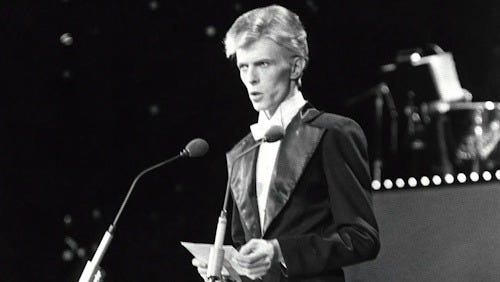
For some artists, the records they made when under the influence of coke stand out, in the way the rings of a tree trunk thin when the environment was difficult. What is remarkable about Bowie is just how good (at least) his music remained. If Young Americans and aspects of Station to Station were surprising, they were still great albums. With the benefit of 20/20 hindsight, we should never have been surprised by any direction Bowie took anyway.
And so to the Thin White Duke, a new Bowie character introduced to us in the title track. This is where researching pieces such as this gets interesting. I’d always believed that Bowie’s ‘fascist era’ - such as it was - was part of the Thin White Duke character, influenced by the previously mentioned consumption of certain substances. It’s a more interesting story than that.
Bowie did make provocative comments at the time:
“As I see it I am the only alternative for the premier in England. I believe Britain could benefit from a fascist leader. After all, fascism is really nationalism.”
David Bowie, quoted in the Bowie Bible.
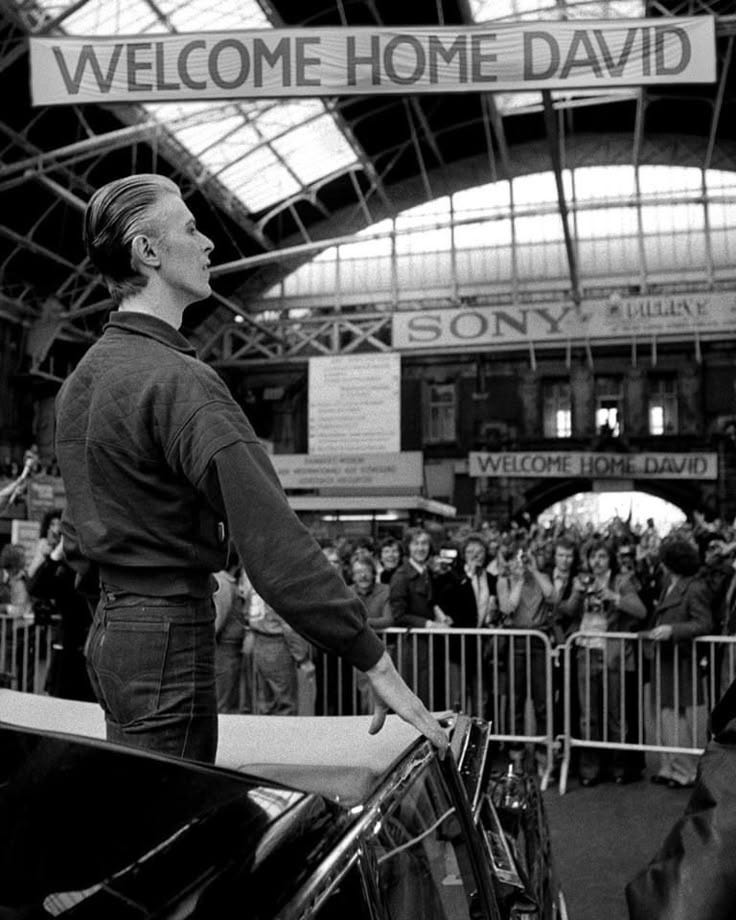
And then, as part of his 1976 tour, he arrived at Victoria Station in London. His fear of flying necessitated this arrival by train. He was photographed giving an apparently fascist salute, but the camera sometimes lies. Bowie maintained he was simply waving. The photograph caught him in an unfortunate gesture, with possibly a little light manipulation as well. Perhaps his incident was the result of his testing a new character, and maybe he was trying out what it felt like to be a powerful leader. If Bowie could be said to be any of his characters at that time, it was of course one that was thin and very white.
The first sounds we hear, with the question running in our heads about how far the plastic soul of Young Americans could be pushed, turns out to be nothing like the Philly sound. We hear a foreshadowing of Bowie’s Berlin period. The sound of a train filtered though white noise flows from the left to right channels before the song builds into what is more recognisably music, and the uncompromising “Return of the Thin White Duke/Throwing darts in lovers eyes” lyric. This was Kraftwerk’s Trans-Europe Express before Kraftwerk thought of it, and not really anything to do with trains anyway.
Despite the railway soundscape, the reference here is to the Stations of the Cross, not railway stations (despite his appearance at Victoria Station, which was my gateway to the bright lights of London when I was a teenager).
‘Station to Station’, the track, is epic, both in length (it clocks in at 10 mins, and is the longest song he ever released) and ambition. This was a time when Bowie became interested in the occult. Bowie was never one to do things by halves and he was reading all the texts he could muster on the topic, which of course led him further into the history of the Third Reich and other difficult areas. (Rock stars and the occult is a whole other post for another day - for example, see also Jimmy Page).
Elsewhere, there are two hit songs. ‘Golden Years’ nails a dance rhythm with Bowie’s delivery of the verse bordering on rap, offering a link back to Americans. ‘TVC 15’, despite its science-fiction title, is from the same genre. The “transmission/transition” section is both captivating and meaningful. Here is another broadcast from Bowie. And to broadcast is to change.
Sandwiched between the two is the gorgeous ‘Word on a Wing’. For all his exploration of the occult, this song is an open prayer for help. Bowie described it as a hymn. It’s possibly the key to his state of mind while writing Station to Station. He was aware of the problems induced by his cocaine habit, knew he needed help, and didn’t immediately know where to find it. So he sought help using the best method he knew how to access - music and songwriting.
The following track, ‘Stay’, is a funky masterclass by guitarists Carlos Alomar and Earl Slick. They are incredible. There’s an Easter egg in this one. According to the Bowie Bible (also an incredible piece of work) the song shares the chords and structure of ‘John, I’m Only Dancing (Again)’, itself a reworking of his hit single from another era - well, four years earlier, which was a longer period of time then than it is now (well, it was at my age then).
We’ve travelled a long way from an opening sequence of pre-Kraftwerk soundscapes to a funk workout that might have taken the ‘plastic’ out of the soul of Young Americans, had it been available then. Bowie could have closed the album by revising ‘Station’, perhaps with the ‘train’ speeding away from the Stations of the Cross in a shorter version of the sound. But this isn’t a concept album, more one with a spiritual/occult/personal crisis theme, so instead we get a cover version.
I last wrote a little about ‘Wild is the Wind’ when reviewing Tanita Tikaram’s latest album, LIAR, as she covers it too. Bowie included it here as an homage to Nina Simone, whose version had deeply affected him, and who had become a friend. It is a beautiful song, written by Dimitri Tiomkin, Ned Washington for the film of the same name, where it appeared sung by Johnny Mathis.
The two moments of stillness in the eye of the storm have titles that seem to speak to each other: ‘Word on a Wing’ and ‘Wild is the Wind’. Only Bowie knows if that was planned, but this is David Bowie at work …
Station to Station acts as bridge to the next phase of Bowie’s creative development, his Berlin trilogy of Low, “Heroes”, and Lodger, made with Brian Eno. A little like Bowie’s entire career, the listener can never be sure where the album is going next, but it’s always interesting, thoughtful, and sometimes danceably exciting.
Original release: 23 January 1976
Current release
50th Ann vinyl remaster (details). A 5CD/1DVD super deluxe edition, with alternative versions and live material, is also available, as well as a standard CD.
Tracks
Station to Station
Golden Years
Word on a Wing
TVC15
Stay
Wild is the Wind
Musicians
David Bowie: vocals, guitar, saxophone, Moog synthesizer, Chamberlin, harmonium
Carlos Alomar, Earl Slick: guitar
Roy Bittan: piano
George Murray: bass guitar
Dennis Davis: drums
Warren Peace: backing vocals
Harry Maslin: saxophone
Producers
David Bowie, Harry Maslin
Further listening
Young Americans
Low / “Heroes” / Lodger (Berlin trilogy)
Further reading
Earl Slick - Guitar (aff.)
Peter Ormerod - David Bowie and the Search for Life, Death and God (aff.)
Acknowledgment
bowiebible.com provided background information for this piece. From the people who brought you beatlesbible.com, this is an amazing resource for anyone interested in any aspect of the life and music of David Bowie.
Next up in LP
Every Tuesday (changed from Monday), I post a new review. On the first Tuesday of the month, this becomes a super deluxe review for paid subscribers.
Randomly, shorter reviews and/or videos will appear in Substack Notes.
LP>Playlist #066, together with my listening guide, will be with you on 5 February.
I’ve already commented on your last Substack about Station to Station and this comment is about Bowie’s weight. When looking back at his career, he was always thin in a way a super model used to be. No matter how gaunt he was, clothes always looked amazing on him. Think back to his Ziggy Stardust era. He looked as if he just walked off the catwalk to perform. The only other person that comes to mind when dealing with extreme fashion sense and the ability to carry it off is the late great Robert Palmer, Mr. Slick and Suave! Maybe you could do a deep dive on Sneakin Sally Through the Alley with another late great, Lowell George and the incredible rhythm section of Little Feat.
This album is one of those records I somehow forget about—and every time I return to it, I’m stunned all over again. Station to Station never feels small. It feels like a pivot point in Bowie’s entire arc: unstable, ambitious, spiritually searching, and musically fearless.
I appreciate how you frame it as both a bridge and a crisis document—not just the Thin White Duke mythology, but the actual creative engine behind it. Your take on “Word on a Wing” as the emotional key especially resonates. That song alone feels like Bowie admitting, in real time, that he was in trouble and reaching for something higher.
This was a great excuse to put the record back on—loud.